





Earth science topics for college cover some of the most dynamic and interdisciplinary areas in modern education. These topics explore how the planet works, how natural systems interact, and how human activity influences Earth’s future. Therefore, college students studying geology, environmental science, climate science, or geography often need strong earth science topics for college assignments, presentations, and research papers.
However, choosing the right topic can be challenging. Many students either select topics that are too broad or choose subjects that lack enough academic sources. As a result, their research becomes difficult and unfocused.
This guide provides carefully selected earth science topics for college students across major subfields. Moreover, each category includes explanations and research angles so you can easily develop assignments, projects, or thesis ideas.
Whether you need a presentation topic, research theme, or dissertation direction, these earth science topics will help you start with clarity and confidence.
What Are Earth Science Topics?
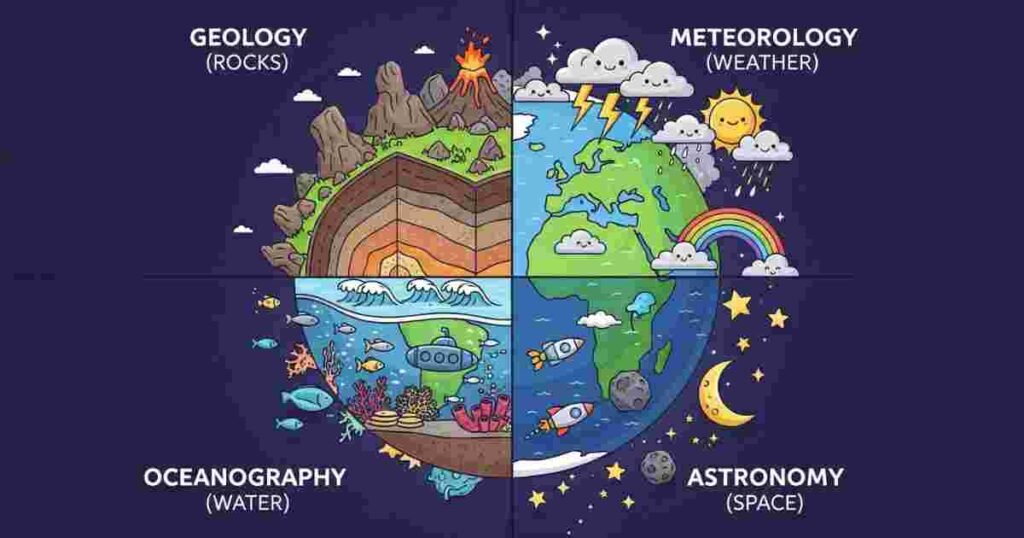
Earth science topics refer to academic subjects that study the Earth’s physical systems, processes, and environmental interactions. These topics typically fall into major branches such as geology, climatology, oceanography, hydrology, and environmental science.
In college-level research, earth science topics usually focus on:
- planetary processes
- natural hazards
- climate systems
- ecosystems and resources
- human-environment interaction
For example, instead of choosing a broad subject like “climate change,” students often narrow it to a specific research angle such as “urban heat island effects in coastal cities.”
Consequently, strong topics lead to better research quality and clearer academic arguments.
How to Choose a Good Earth Science Topic for College
Before exploring topic lists, it is important to understand what makes a good college-level earth science topic.
A strong topic should be:
- specific rather than broad
- researchable with academic sources
- relevant to current environmental issues
- suitable for your course level
- interesting to you personally
Additionally, modern earth science research increasingly connects with sustainability, climate resilience, and environmental management. Therefore, selecting topics aligned with current global challenges often improves both grades and research impact.
Geology Topics for College Research
Geology focuses on Earth’s structure, materials, and long-term processes. Since geology connects with resources, hazards, and environmental change, it remains one of the most important earth science fields.
Structural and Physical Geology Topics
- Plate tectonics and continental drift patterns
- Mountain formation processes and tectonic stress
- Earthquake distribution along fault lines
- Rock deformation and crustal movement
- Geological mapping techniques in modern research
- Subduction zones and volcanic activity relationships
- Lithospheric plate boundaries and hazards
- Continental collision and crustal thickening
- Seismic wave analysis in Earth studies
- Geological stress accumulation models
These topics work well for tectonics, structural geology, and hazard courses.
Mineralogy and Petrology Topics
- Mineral formation under extreme pressure
- Igneous rock formation and magma cooling rates
- Metamorphic rock transformation processes
- Crystal structure analysis in minerals
- Economic mineral deposits and formation
- Volcanic rock composition studies
- Mantle-derived minerals and geochemistry
- Rock cycle interactions in Earth systems
- Rare earth element distribution in rocks
- Mineral stability in changing environments
Such topics are useful for laboratory geology or geochemistry classes.
Climate Science Topics for College
Climate science examines atmospheric systems, climate variability, and long-term environmental change. Because climate change dominates modern research, climate topics are highly relevant and widely studied.
Climate Change Research Topics
- Regional climate change trends over decades
- Human contribution to global warming patterns
- Climate feedback loops in Earth systems
- Polar ice melt and sea level rise
- Climate tipping points and risk analysis
- Greenhouse gas concentration trends
- Climate modeling accuracy and prediction
- Extreme weather frequency changes
- Climate mitigation strategies effectiveness
- Carbon cycle disruptions in modern climate
These topics are ideal for climate science, environmental science, or geography students.
Atmospheric Science Topics
- Atmospheric circulation patterns and weather
- Jet streams and climate variability
- Monsoon systems and regional climate
- Aerosols and atmospheric chemistry
- Ozone layer depletion mechanisms
- Air pollution transport across regions
- Atmospheric pressure systems and storms
- Cloud formation and climate interaction
- Solar radiation and climate balance
- Tropospheric temperature gradients
Such topics suit meteorology or atmospheric science courses.
Oceanography Topics for College Students
Oceanography studies marine systems, ocean circulation, and ocean-climate interaction. Since oceans regulate climate and ecosystems, marine research is increasingly important.
Physical Oceanography Topics
- Ocean circulation and global heat transfer
- Thermohaline circulation patterns
- Ocean currents and climate influence
- Sea surface temperature variability
- Coastal upwelling processes
- Ocean stratification and mixing
- Tides and gravitational forces
- Ocean-atmosphere interaction systems
- El Niño and La Niña dynamics
- Marine heatwave trends
These topics connect with climate science and marine physics.
Marine Environmental Topics
- Ocean acidification impacts on ecosystems
- Coral reef degradation causes
- Marine pollution distribution patterns
- Plastic accumulation in oceans
- Coastal ecosystem vulnerability
- Marine biodiversity loss drivers
- Oil spill environmental effects
- Ocean oxygen depletion zones
- Overfishing ecological consequences
- Coastal habitat destruction
These are strong topics for environmental science students.
Hydrology and Water Science Topics
Hydrology focuses on water movement, distribution, and availability on Earth. Because water security is a global issue, hydrology topics are highly relevant today.
Surface and Groundwater Topics
- Groundwater depletion and sustainability
- Aquifer recharge processes
- River flow variability and climate
- Watershed management strategies
- Flood frequency analysis
- Drought prediction models
- Surface-groundwater interaction
- River sediment transport
- Hydrological cycle disruptions
- Water table fluctuations
These topics work well in water resource courses.
Water Quality and Management Topics
- Drinking water contamination sources
- Agricultural runoff impacts
- Urban water pollution trends
- Wastewater treatment effectiveness
- Heavy metal contamination in water
- Nutrient loading in lakes
- Water purification technologies
- Microplastics in freshwater
- Industrial discharge effects
- Water scarcity management strategies
Such topics connect hydrology with environmental science.
Environmental Earth Science Topics
Environmental earth science examines how natural systems interact with human activities. Therefore, it often focuses on sustainability, conservation, and environmental risk.
Human Impact on Earth Systems
- Deforestation and soil degradation
- Urbanization and land cover change
- Mining impacts on landscapes
- Agricultural land use change
- Desertification processes
- Soil erosion and conservation
- Habitat fragmentation patterns
- Human-induced geomorphology
- Industrialization and environmental change
- Resource extraction impacts
These topics are interdisciplinary and widely used in research.
Sustainability and Resource Topics
- Renewable energy resource distribution
- Sustainable land management
- Resource depletion trends
- Environmental policy effectiveness
- Carbon sequestration strategies
- Sustainable agriculture systems
- Ecological restoration methods
- Resource conservation planning
- Circular economy in resources
- Sustainable urban development
Such topics align with modern sustainability studies.
Natural Hazards and Disaster Topics
Natural hazards are a major earth science field because they affect human safety and infrastructure. Consequently, hazard research combines geology, climate science, and environmental planning.
Geological Hazards Topics
- Earthquake risk assessment models
- Volcanic eruption prediction
- Landslide triggering factors
- Tsunami formation mechanisms
- Seismic hazard mapping
- Fault line activity analysis
- Volcano monitoring techniques
- Ground shaking intensity studies
- Landslide susceptibility mapping
- Submarine landslide risks
These topics suit hazard geology or geophysics courses.
Climate-Related Hazards Topics
- Hurricane intensity trends
- Flood risk under climate change
- Heatwave frequency analysis
- Drought severity patterns
- Wildfire climate relationships
- Storm surge impacts
- Coastal flooding risk
- Extreme rainfall events
- Climate-driven disasters
- Hazard resilience strategies
These topics connect climate science with disaster management.
Earth System Science Topics
Earth system science studies interactions among atmosphere, oceans, land, and biosphere. Because modern science emphasizes systems thinking, these topics are highly advanced and valuable.
- Earth system feedback mechanisms
- Biosphere-climate interactions
- Carbon cycle disruptions
- Land-atmosphere coupling
- Global biogeochemical cycles
- Earth system modeling
- Planetary boundaries concept
- Ecosystem-climate feedback
- Earth energy balance
- Coupled climate systems
Such topics are ideal for advanced college or graduate students.
Remote Sensing and Geospatial Topics
Modern earth science increasingly relies on satellite data and geographic information systems (GIS). Therefore, geospatial topics are both modern and career-relevant.
- Satellite monitoring of deforestation
- Remote sensing of climate change
- GIS mapping of hazards
- Land use change detection
- Urban expansion analysis
- Glacier retreat monitoring
- Coastal erosion mapping
- Vegetation change tracking
- Drought monitoring via satellites
- Environmental change detection
These topics combine technology with earth science research.
Easy Earth Science Topics for College Assignments
Some students need simpler topics for short essays or presentations. Therefore, the following subjects are easier yet still academic.
- Causes of earthquakes
- Types of volcanoes
- Rock cycle explanation
- Water cycle processes
- Climate zones of Earth
- Ocean current systems
- Soil formation factors
- Renewable energy resources
- Flood causes and impacts
- Weather vs climate differences
These topics suit introductory courses.
Advanced Earth Science Research Topics
For thesis or major projects, advanced topics are often required. Consequently, the following ideas are more analytical and research-intensive.
- Climate tipping point modeling
- Earth system resilience analysis
- Anthropocene geological evidence
- Cryosphere dynamics and climate
- Ocean-carbon feedback mechanisms
- Geochemical cycle disruption
- Climate adaptation strategies
- Planetary boundary thresholds
- Coupled hazard systems
- Integrated Earth modeling
Such topics fit senior or graduate research.
Interdisciplinary Earth Science Topics
Modern research increasingly combines multiple disciplines. Therefore, interdisciplinary topics are highly valued in college research.
- Climate change and agriculture
- Urban climate impacts
- Environmental economics of resources
- Climate migration patterns
- Sustainable cities and geology
- Water-energy-food nexus
- Environmental policy and science
- Climate justice and geography
- Ecosystem services valuation
- Land use and climate feedback
These topics connect science with society.
Tips to Turn Topics into Research Papers
Choosing a topic is only the first step. However, students often struggle to convert ideas into full research projects.
To develop a strong paper:
- Narrow the topic
- Define a research question
- Identify variables or factors
- Review academic sources
- Choose a method
- Present analysis
For example:
Broad topic: climate change
Focused topic: urban heat island
Research question: How does urbanization influence heat intensity in coastal cities?
Consequently, a clear question leads to better structure and argument.
Why Earth Science Topics Matter Today
Earth science research has become increasingly important because human activity now influences planetary systems. Climate change, resource depletion, and environmental hazards all require scientific understanding.
Therefore, studying earth science helps:
- understand environmental risks
- support sustainability planning
- predict natural hazards
- manage resources
- protect ecosystems
In addition, earth science careers continue to grow in environmental consulting, climate research, GIS analysis, and sustainability planning.
Conclusion
Earth science covers the processes, systems, and interactions that shape our planet. Because the field is broad and interdisciplinary, college students have many possible research directions.
This guide presented over 100 earth science topics across geology, climate science, oceanography, hydrology, hazards, sustainability, and Earth systems. Moreover, each category included explanations to help students choose topics confidently.
Selecting a focused, relevant topic is the first step toward strong academic research. Once you narrow your interest and define a clear question, developing assignments and projects becomes much easier.
Ultimately, earth science education helps students understand the planet’s past, present, and future. As environmental challenges grow, these topics become even more valuable for both research and careers.